Efficient cellar rehabilitation
Damp cellars are a big problem. Regardless of whether you use your cellar for storage or as a hobby room, an office or children's playroom: it is important to keep it dry at all times. But that is not always easy, especially in old buildings. We can help you – firstly by identifying the cause of the problem.
Condensation of air humidity
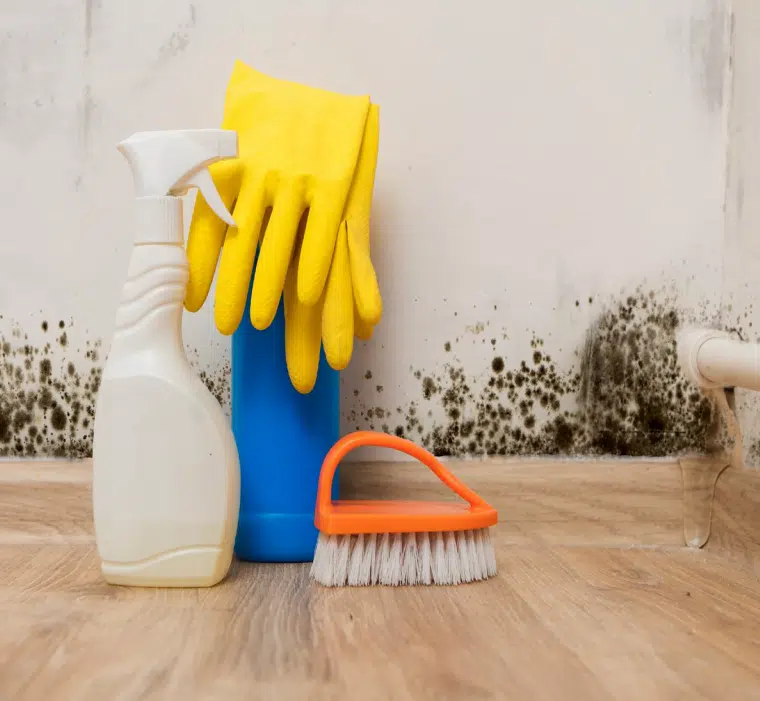
Moisture can form condensate if your house has thermal bridges, i.e. if it is insufficiently insulated in certain areas. You tell by feeling for cold spots on walls. The problem is that the warm indoor air deposits humidity on the cold part of the building. In extreme cases, this can lead to mould formation.
Our solution
If possible, we re-insulate poorly insulated buildings. We also investigate the options of automated ventilation.
Pressing penetrating water
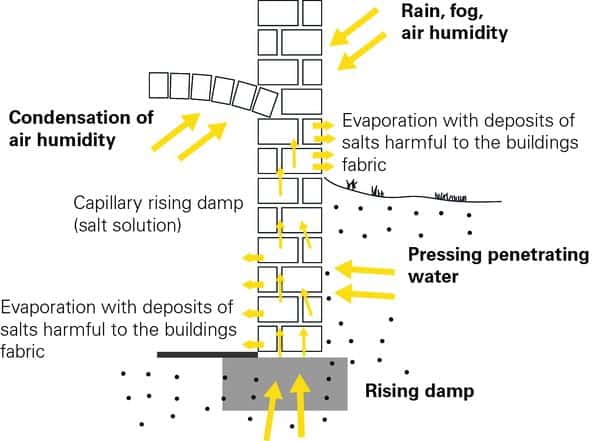
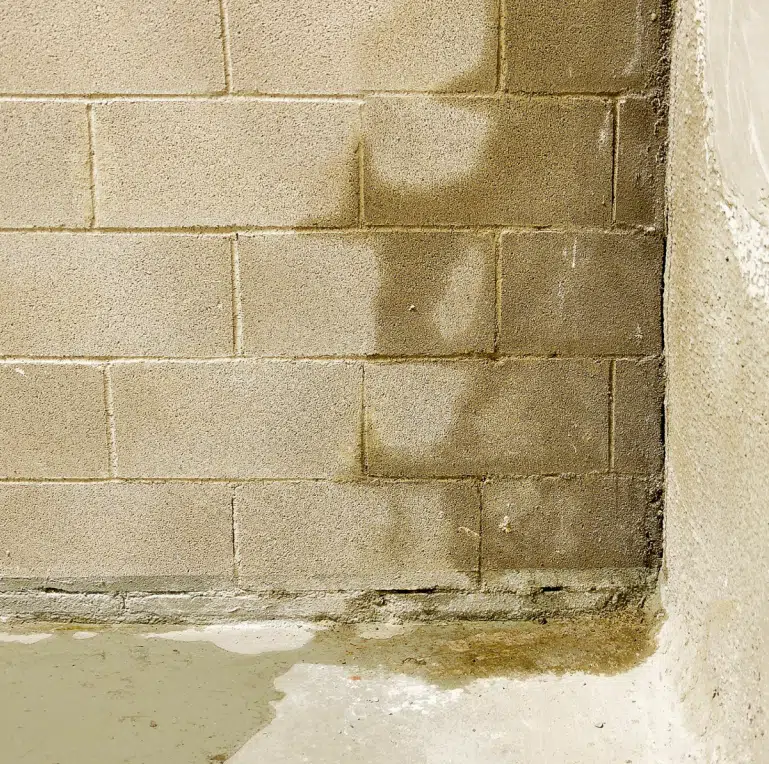
Pressing water can have a number of causes. It can penetrate the brickwork as groundwater or water running off a slope, or it can take the form of rainwater, fog or air humidity. Water penetrating after rainfall usually takes the form of pressing water. The cellar needs to be sealed off in the right areas.
Our solution
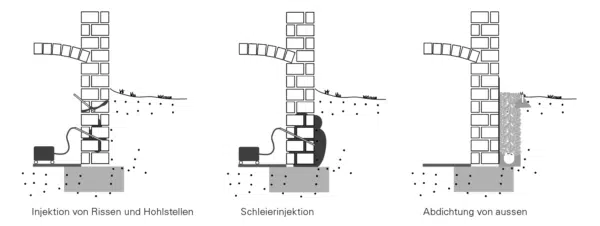
We locate the structural weak point in your cellar and eliminate it. Localised weak points can be treated by way of injection. Larger weak areas can be sealed by way of curtain injection. In rare cases, it may be necessary to seal the structure from the outside.
Rising damp
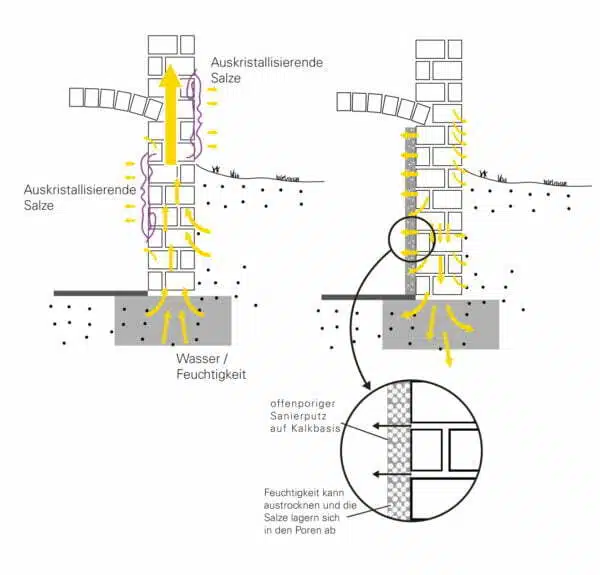
Rising damp is responsible for 80% of all damp cellars. This problem is known as capillarity. It describes how surface tension causes water to rise inside a tight channel – despite gravity. Every wall has thousands of hair-like channels containing salts. These are ideal conditions for rising damp. One consequential problem of capillarity is that groundwater brings with it more salts that are deposited on the walls. This promotes even more rising damp and the walls become wetter still. The rendering begins to fall off and an unpleasant musty smell permeates the air.
Our solution
We work with Ecodry devices that counteract capillarity. They destroy the salt structure in the building fabric. Water can no longer rise up through the effect of capillarity. The building dries out over time and the damp disappears from your cellar. This is a very tried and tested procedure. In some cases, it may be expedient to apply a restoration render around the base. This open-pore render has sufficient volume to accommodate rising salts.
Floor by floor, renovation in Central 2 Zurich
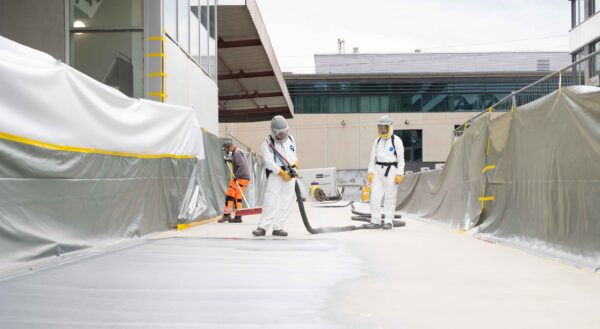
Polyurea coating parking deck Köniz: Protection for concrete and reinforcement